
Bozeman Residential Landscape Architects
Residential landscape architecture in Bozeman is shaped by a setting that most clients already feel strongly about before any design work begins. The Bridger Mountains to the north. The Spanish Peaks to the southwest. The Gallatin River running through the valley floor. The wide-open quality of the sky. These aren’t incidental features of the properties we work on, they’re the primary reasons people choose to live here, and a landscape design that doesn’t take them seriously isn’t doing its job.
At EBD Studios, we approach each Bozeman project as a site-specific design problem. The conditions of the Gallatin Valley, its climate, its terrain, its native plant community, its visual context, are the starting point for every design decision. What works in Santa Barbara or Scottsdale doesn’t simply translate here. This place has its own logic, and good landscape architecture follows that logic rather than overriding it.
The Discipline of Designing for Cold
Bozeman’s winters set a high bar for every material and system we specify. Surfaces must handle repeated freeze-thaw cycling without cracking or spalling. Drainage systems must manage the volume of spring snowmelt without eroding pathways or flooding patios. Planting selections must be cold-hardy enough to return reliably each spring after sustained temperatures well below zero. Structures must handle significant snow load. These aren’t edge cases, they’re baseline requirements, and they shape the design from the first conversation.
The compressed growing season changes the design calculus in other ways too. With a frost-free window of roughly 90 to 120 days depending on the specific microclimate, every planting choice has to deliver more across a shorter period. We select species that provide interest from the moment they emerge in spring through the first hard frosts of fall, and that hold visual character through the dormant months rather than disappearing until May.
Terrain, Drainage, and Site Logic
The Gallatin Valley isn’t uniformly flat, and properties at the edges of Bozeman, on the benches north of town, in the foothills neighborhoods to the south and west, or on rural lots outside the city limits, often come with significant grade change and complex drainage conditions. We treat these site conditions as design opportunities rather than problems to be minimized. Retaining walls, terracing, and level changes create spatial variety and outdoor rooms with distinct character. Drainage systems are integrated into the design as functional elements rather than concealed afterthoughts.
The relationship between the designed landscape and the surrounding natural terrain is something we think about carefully on every Bozeman project. Where does the designed edge end and the native landscape begin? How does that transition look and feel from inside the property? From the street? From inside the home? Handling that boundary well is one of the things that distinguishes a landscape that feels like it belongs here from one that doesn’t.
Outdoor Living Across the Full Season
Bozeman residents use their outdoor spaces intensely and across a wide seasonal range. Early spring days when the snow is still on the Bridgers but the yard is dry enough to sit outside. The long, clear evenings of midsummer. The September and October weeks when the larch trees are turning and the air has that particular quality that makes extended time outside feel urgent. We design for all of it, creating outdoor environments with enough spatial variety and flexibility to support different kinds of use at different times of year.
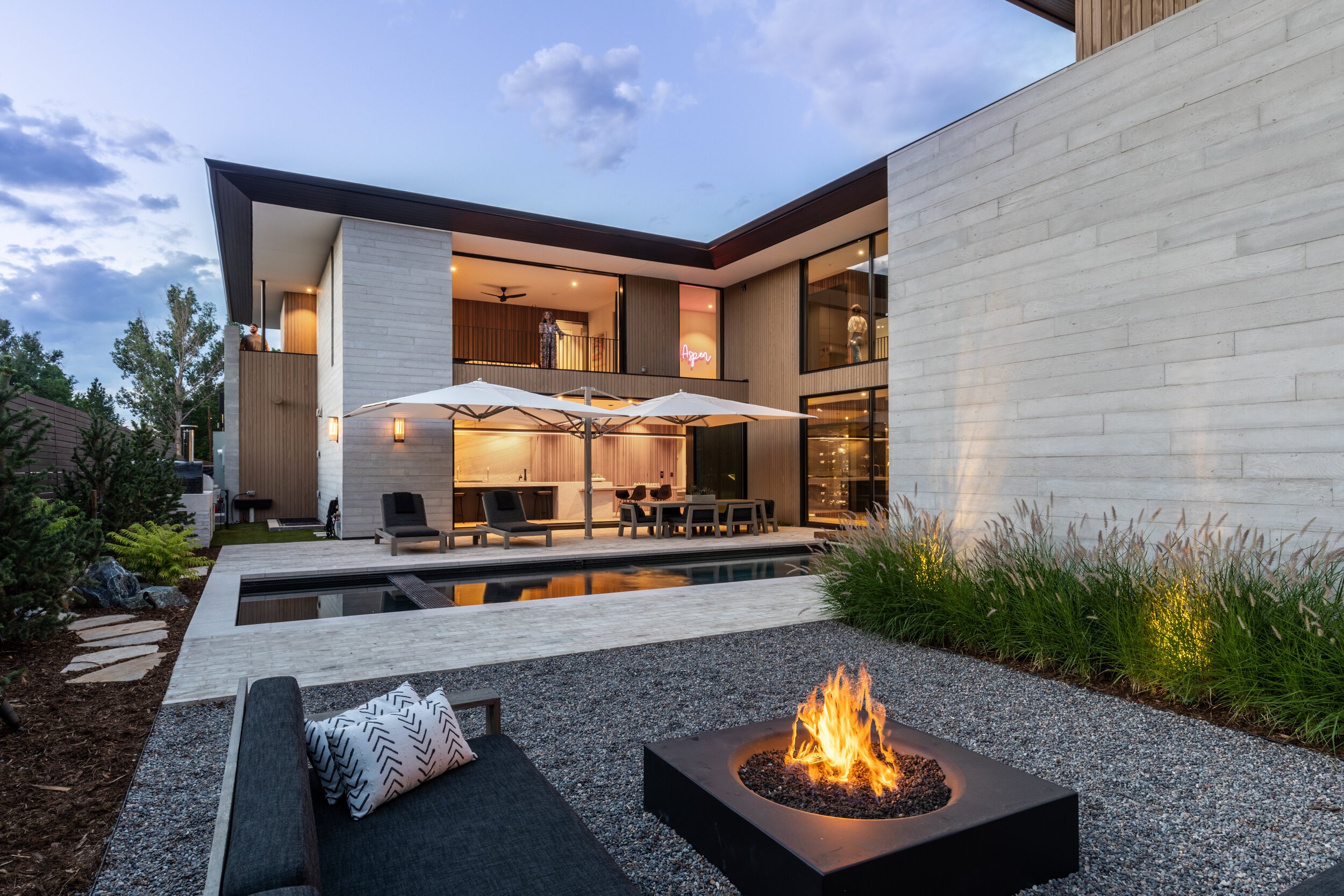
Fire features extend the season significantly and are a standard component of well-designed Bozeman outdoor spaces. Covered structures or pergolas provide protection during the afternoon thunderstorms that move through the valley in summer. Planted screens and low walls create shelter from the wind that makes shoulder-season comfort possible.
Plantings Rooted in the Gallatin Valley
Our planting approach in Bozeman begins with the native and regionally adapted plant communities of the Northern Rockies. Native grasses like Idaho fescue and blue grama. Shrubs like serviceberry, chokecherry, and shrubby cinquefoil that provide multi-season interest and wildlife value. Trees like quaking aspen, cottonwood, and limber pine that give scale and seasonal character to the landscape. These are plants that know this climate and don’t need to be coaxed through it. Building from this foundation produces landscapes that look genuinely at home in the Gallatin Valley and improve with each passing season.
The Full Design Process
Every project begins with a thorough site analysis. Grade, drainage, sun exposure, wind patterns, existing vegetation, soil conditions, and views are all documented before design work begins. Concept drawings establish the overall direction and spatial organization. Construction drawings provide the precision contractors need to build accurately to the design intent.
We coordinate with contractors during construction, verifying that materials, grading, and drainage are being executed as designed. The goal is a finished landscape that matches the intent of the design and performs without issue from the first season.
Begin Your Landscape Architecture Project in Bozeman
If you’re planning a comprehensive landscape project for your Bozeman property, EBD Studios can guide you through a design process built on Gallatin Valley site knowledge, cold-climate material expertise, and long-term thinking. We design outdoor environments that belong to this place, hold their character through every season, and make the most of what the Northern Rockies landscape genuinely has to offer.